---
title: "2 Conformance"
chapter: "2 Conformance"
source: "OMG BPMN 2.0.2 — formal/2013-12-09"
pages: "1-12"
---
> 2 Conformance · páginas 1-12 · [índice](README.md)
# 2 Conformance
## 2.1 General
Software can claim compliance or conformance with **BPMN 2.0** if and only if the software fully matches the applicable compliance points as stated in the International Standard. Software developed only partially matching the applicable compliance points can claim only that the software was based on this International Standard, but cannot claim compliance or conformance with this International Standard. The document defines four types of conformance namely **Process Modeling Conformance**, **Process Execution Conformance**, **BPEL Process Execution Conformance**, and **Choreography Modeling Conformance**. The implementation claiming conformance to **Process Modeling Conformance** type is NOT REQUIRED to support **Choreography Modeling Conformance** type and vice-versa. Similarly, the implementation claiming **Process Execution Conformance** type is NOT REQUIRED to be conformant to the **Process Modeling** and **Choreography Conformance** types. The implementation claiming conformance to the **Process Modeling Conformance type** SHALL comply with all of the requirements set forth in sub clause 2.1. The implementation claiming conformance to the **Process Execution Conformance type** SHALL comply with all of the requirements set forth in sub clause 2.2. The implementation claiming conformance to the **BPEL Process Execution Semantics Conformance type** SHALL comply with all of the requirements set forth in sub clause 2.3. The implementation claiming conformance to the **Choreography Conformance type** SHALL comply with all of the requirements set forth in sub clause 2.4. The implementation is said to have **BPMN Complete Conformance** if it complies with all of the requirements stated in sub clauses 2.1, 2.2, 2.3, and 2.4.
## 2.2 Process Modeling Conformance
The next eight sub clauses describe **Process Modeling Conformance**.
### 2.2.1 BPMN Process Types
The implementations claiming **Process Modeling Conformance** MUST support the following **BPMN** packages:
- The **BPMN** core elements, which include those defined in the *Infrastructure*, *Foundation*, *Common*, and *Service* packages (see Clause 8).
- **Process** diagrams, which include the elements defined in the **Process**, **Activities**, *Data*, and *Human Interaction* packages (see Clause 10).
- **Collaboration** diagrams, which include **Pools** and **Message Flow** (see Clause 9).
- **Conversation** diagrams, which include **Pools**, **Conversations**, and **Conversation Links** (see Clause 9).
As an alternative to full **Process Modeling Conformance**, there are three conformance sub-classes defined:
- **Descriptive**
- **Analytic**
- **Common Executable**
**Descriptive** is concerned with visible elements and attributes used in high-level modeling. It should be comfortable for analysts who have used BPA flowcharting tools. **Analytic** contains all of **Descriptive** and in total about half of the constructs in the full **Process Modeling Conformance** Class. It is based on experience gathered in BPMN training and an analysis of user-patterns in the Department of Defense Architecture Framework and planned standardization for that framework. Both **Descriptive** and **Analytic** focus on visible elements and a minimal subset of supporting attributes/elements. **Common Executable** focuses on what is needed for executable process models. Elements and attributes not in these sub-classes are contained in the full **Process Modeling Conformance** class. The elements for each sub-class are defined in the next sub clause.
### 2.2.2 BPMN Process Elements
The **Process Modeling Conformance** type set consists of **Collaboration** and **Process** diagram elements, including all **Task** types, *embedded* **Sub-Processes**, **CallActivity**, all **Gateway** types, all **Event** types (**Start**, **Intermediate**, and **End**), **Lane**, *Participants*, **Data Object** (including **DataInput** and **DataOutput**), **Message**, **Group**, **Text Annotation**, **Sequence Flow** (including *conditional* and *default* flows), **Message Flow**, **Conversations** (limited to grouping **Message Flow**, and associating *correlations*), *Correlation*, and **Association** (including **Compensation Association**). The set also includes markers (**Loop**, **Multi-Instance**, **Transaction**, **Compensation**) for **Tasks** and *embedded* **Sub-Processes**).
**NOTE:** Implementations are not expected to support **Choreography** modeling elements such as **Choreography Task** and
For a tool to claim support for a sub-class the following criteria MUST be satisfied:
- All the elements in the sub-class MUST be supported.
- For each element, all the listed attributes MUST be supported.
- In general, if the sub-class doesn’t mention an attribute and it is NOT REQUIRED by the schema, then it is not in the subclass. Exceptions to this rule are noted.
#### Descriptive Conformance Sub-Class
The **Descriptive** conformance sub-class elements are shown in Table 2.1.
**Table 2.1 – Descriptive Conformance Sub-Class Elements and Attributes**
| Element | Attributes |
| --- | --- |
| participant (pool) | id, name, processRef |
| laneSet | id, lane with name, childLaneSet, flowElementRef |
| sequenceFlow (unconditional) | id, name, sourceRef, targetRef |
| messageFlow | id, name, sourceRef, targetRef |
| exclusiveGateway | id, name |
| parallelGateway | id, name |
| task (None) | id, name |
| userTask | id, name |
| serviceTask | id, name |
| subProcess (expanded) | id, name, flowElement |
| subProcess (collapsed) | id, name, flowElement |
| CallActivity | id, name, calledElement |
| DataObject | id, name |
| TextAnnotation | id, text |
| association/dataAssociationa | id, name, sourceRef, targetRef, associationDirectionb |
| dataStoreReference | id, name, dataStoreRef |
| startEvent (None) | id, name |
| endEvent (None) | id, name |
| messageStartEvent | id, name, messageEventDefinition |
| messageEndEvent | id, name, messageEventDefinition |
| timerStartEvent | id, name, timerEventDefinition |
| terminateEndEvent | id, name, terminateEventDefinition |
| cdocumentation | text |
| Group | id, categoryRef |
a. **Data Association** is ABSTRACT: **Data Input Association** and **Data Output Association** will appear in the XML serialization. These both have REQUIRED attributes [sourceRef and targetRef] which refer to itemAwareElements. To be consistent with the metamodel, this will require the following additional elements: ioSpecification, inputSet, outputSet, **Data Input**, **Data Output**. When a **BPMN** editor draws a **Data Association** to an **Activity** or **Event** it should generate this supporting invisible substructure. Otherwise, the metamodel would have to be changed to make sourceRef and targetRef optional or allow reference to non-itemAwareElements, e.g., **Activity** and **Event**.
b. associationDirection not specified for **Data Association**
c. Documentation is not a visible element. It is an attribute of most elements.
#### Analytic Conformance Sub-Class
The **Analytic** conformance sub-class contains all the elements of the **Descriptive** conformance sub-class plus the elements shown in Table 2.2.
**Table 2.2 – Analytic Conformance Sub-Class Elements and Attributes**
| Element | Attributes |
| --- | --- |
| sequenceFlow (conditional) | id, name, sourceRef, targetRef, conditionExpressiona |
| sequenceFlow (default) | id, name, sourceRef, targetRef, defaultb |
| sendTask | id, name |
| receiveTask | id, name |
| Looping Activity | standardLoopCharacteristics |
| MultiInstance Activity | multiInstanceLoopCharacteristics |
| exclusiveGateway | Add default attribute |
| inclusiveGateway | id, name, eventGatewayType |
| eventBasedGateway | id, name, eventGatewayType |
| Link catch/throw Intermediate Event | Id, name, linkEventDefinition |
| signalStartEvent | id, name, signalEventDefinition |
| signalEndEvent | id, name, signalEventDefinition |
| Catching message Intermediate Event | id, name, messageEventDefinition |
| Throwing message Intermediate Event | id, name, messageEventDefinition |
| Boundary message Intermediate Event | id, name, attachedToRef, messageEventDefinition |
| Non-interrupting Boundary message Intermediate Event | id, name, attachedToRef, cancelActivity=false, messageEventDefinition |
| Catching timer Intermediate Event | id, name, timerEventDefinition |
| Boundary timer Intermediate Event | id, name, attachedToRef, timerEventDefinition |
| Non-interrupting Boundary timer Intermediate Event | id, name, attachedToRef, cancelActivity=false, timerEventDefinition |
| Boundary error Intermediate Event | id, name, attachedToRef, errorEventDefinition |
| errorEndEvent | id, name, errorEventDefinition |
| Non-interrupting Boundary escalation Intermediate Event | id, name, attachedToRef, cancelActivity=false, escalationEventDefinition |
| Throwing escalation Intermediate Event | id, name, escalationEventDefinition |
| escalationEndEvent | id, name, escalationEventDefinition |
| Catching signal Intermediate Event | id, name, signalEventDefinition |
| Throwing signal Intermediate Event | id, name, signalEventDefinition |
| Boundary signal Intermediate Event | id, name, attachedToRef, signalEventDefinition |
| Non-interrupting Boundary signal Intermediate Event | id, name, attachedToRef, cancelActivity=false, signalEventDefinition |
| conditionalStartEvent | id, name, conditionalEventDefinition |
| Catching conditional Intermediate Event | id, name, conditionalEventDefinition |
| Boundary conditional Intermediate Event | id, name, conditionalEventDefinition |
| Non-interrupting Boundary conditional Intermediate Event | id, name, cancelActivity=false, conditionalEventDefinition |
| cmessage | id, name, add messageRef attribute to messageFlow |
a. ConditionExpression, allowed only for **Sequence Flow** out of **Gateways**, MAY be null.
b. Default is an attribute of a sourceRef (exclusive or inclusive) **Gateway**.
c. Note that messageRef, an attribute of various message **Events**, is optional and not in the sub-class.
#### Common Executable Conformance Sub-Class
This conformance sub-class is intended for modeling tools that can emit executable models. Data type definition language MUST be XML Schema. Service Interface definition language MUST be WSDL. Data access language MUST be XPath. The **Common Executable** conformance sub-class elements are shown in Table 2.3 and its supporting classes in Table 2.4.
**Table 2.3 – Common Executable Conformance Sub-Class Elements and Attributes**
| Element | Attributes |
| --- | --- |
| sequenceFlow (unconditional) | id, (name), sourceRefa, targetRefb |
| sequenceFlow (conditional) | id, name, sourceRef, targetRef, conditionExpressionc |
| sequenceFlow (default) | id, name, sourceRef, targetRef, defaultd |
| subProcess (expanded) | id, name, flowElement, loopCharacteristics, boundaryEventRefs |
| exclusiveGateway | id, name, gatewayDirection (only converging and diverging), default |
| parallelGateway | id, name, gatewayDirection (only converging and diverging) |
| startEvent (None) | id, name |
| endEvent (None) | id, name |
| eventBasedGateway | id, name, gatewayDirection, eventGatewayType |
| userTask | id, name, renderings, implementation, resources, ioSpecification, dataInputAssociations, dataOutputAssociations, loopCharacteristics, boundaryEventRefs |
| serviceTask | id, name, implementation, operationRef, ioSpecification, dataInputAssociations, dataOutputAssociations, loopCharacteristics, boundaryEventRefs |
| callActivity | id, name, calledElement, ioSpecification, dataInputAssociations, dataOutputAssociations, loopCharacteristics, boundaryEventRefs |
| dataObject | id, name, isCollection, itemSubjectRef |
| textAnnotation | id, text |
| dataAssociation | id, name, sourceRef, targetRef, assignment |
| messageStartEvent | id, name, messageEventDefinition (either ref or contained), dataOutput, dataOutputAssociations |
| messageEndEvent | id, name, messageEventDefinition, (either ref or contained), dataInput, dataInputAssociations |
| terminateEndEvent | (Terminating trigger in combination with one of the other end events) |
| Catching message Intermediate Event | id, name, messageEventDefinition (either ref or contained), dataOutput, dataOutputAssociations |
| Throwing message Intermediate Event | id, name, messageEventDefinition (either ref or contained), dataInput, dataInputAssociations |
| Catching timer Intermediate Event | id, name, timerEventDefinition (contained) |
| Boundary error Intermediate Event | id, name, attachedToRef, errorEventDefinition, (contained or referenced), dataOutput, dataOutputAssociations |
a. Multiple outgoing connections are only allowed for converging **Gateways**.
b. Multiple outgoing connections are only allowed for diverging **Gateways**.
c. ConditionExpression, allowed only for **Sequence Flow** out of **Gateways**, MAY be null.
d. Default is an attribute of a sourceRef (exclusive or inclusive) **Gateway**.
**Table 2.4 – Common Executable Conformance Sub-Class Supporting Classes**
| Element | Attributes |
| --- | --- |
| StandardLoopCharacteristics | id, loopCondition |
| MultiInstanceLoopCharacteristics Rendering | id, isSequential, loopDataInput, inputDataItem |
| Resource | id, name |
| ResourceRole | id, resourceRef, resourceAssignmentExpression |
| InputOutputSpecification | id, dataInputs, dataOutputs |
| DataInput | id, name, isCollection, itemSubjectRef |
| DataOutput | id, name, isCollection, itemSubjectRef |
| ItemDefinition | id, structure or importa |
| Operation | id, name, inMessageRef, outMessageRef, errorRefs |
| Message | id, name, structureRef |
| Error | id, structureRef |
| Assignment | id, from, tob |
| MessageEventDefinition | id, messageRef, operationRef |
| TerminateEventDefinition | id |
| TimerEventDefinition | id, timeDate |
a. Structure MUST be defined by an XSD Complex Type
b. Structure MUST be defined by an XSD Complex Type
### 2.2.3 Visual Appearance
A key element of **BPMN** is the choice of shapes and icons used for the graphical elements identified in this International Standard. The intent is to create a standard visual language that all process modelers will recognize and understand. An implementation that creates and displays **BPMN Process** Diagrams SHALL use the graphical elements, shapes, and markers illustrated in this International Standard. **NOTE:** There is flexibility in the size, color, line style, and text positions of the defined graphical elements, except where otherwise specified (see page 41). The following extensions to a **BPMN** Diagram are permitted:
- New markers or indicators MAY be added to the specified graphical elements. These markers or indicators could be used to highlight a specific attribute of a **BPMN** element or to represent a new subtype of the corresponding concept.
- A new shape representing a kind of **Artifact** MAY be added to a Diagram, but the new **Artifact** shape SHALL NOT conflict with the shape specified for any other **BPMN** element or marker.
- Graphical elements MAY be colored, and the coloring MAY have specified semantics that extend the information conveyed by the element as specified in this International Standard.
- The line style of a graphical element MAY be changed, but that change SHALL NOT conflict with any other line style REQUIRED by this International Standard.
- An extension SHALL NOT change the specified shape of a defined graphical element or marker (e.g., changing a square into a triangle, or changing rounded corners into squared corners, etc.).
### 2.2.4 Structural Conformance
An implementation that creates and displays **BPMN** diagrams SHALL conform to the specifications and restrictions with respect to the connections and other diagrammatic relationships between graphical elements. Where permitted or requested connections are specified as conditional and based on attributes of the corresponding concepts, the implementation SHALL ensure the correspondence between the connections and the values of those attributes. **NOTE:** In general, these connections and relationships have specified semantic interpretations, which specify interactions among the process concepts represented by the graphical elements. Conditional relationships based on attributes represent specific variations in behavior. Structural conformance therefore guarantees the correct interpretation of the diagram as a specification of process, in terms of flows of control and information. Throughout the document, structural specifications will appear in paragraphs using a special shaped bullet: Example: ♦ A **TASK** MAY be a target for **Sequence Flow**; it can have multiple *incoming* Flows. An *incoming* Flow MAY be from an alternative path and/or parallel paths.
### 2.2.5 Process Semantics
This International Standard defines many semantic concepts used in defining **Processes**, and associates them with graphical elements, markers, and connections. To the extent that an implementation provides an interpretation of the **BPMN** diagram as a semantic specification of **Process**, the interpretation SHALL be consistent with the semantic interpretation herein specified. In other words, the implementation claiming **BPMN Process Modeling Conformance** has to support the semantics surrounding the diagram elements expressed in Clause 10. **NOTE:** The implementations claiming **Process Modeling Conformance** are not expected to support the **BPMN** execution semantics described in Clause 13.
### 2.2.6 Attributes and Model Associations
This International Standard defines a number of attributes and properties of the semantic elements represented by the graphical elements, markers, and connections. Some of these attributes are purely representational and are so marked, and some have mandated representations. Some attributes are specified as mandatory, but have no representation or only optional representation. And some attributes are specified as optional. For every attribute or property that is specified as mandatory, a conforming implementation SHALL provide some mechanism by which values of that attribute or property can be created and displayed. This mechanism SHALL permit the user to create or view these values for each **BPMN** element specified to have that attribute or property. Where a graphical representation for that attribute or property is specified as REQUIRED, that graphical representation SHALL be used. Where a graphical representation for that attribute or property is specified as optional, the implementation MAY use either a graphical representation or some other mechanism. If a graphical representation is used, it SHALL be the representation specified. Where no graphical representation for that attribute or property is specified, the implementation MAY use either a graphical representation or some other mechanism. If a graphical representation is used, it SHALL NOT conflict with the specified graphical representation of any other **BPMN** element.
### 2.2.7 Extended and Optional Elements
A conforming implementation is NOT REQUIRED to support any element or attribute that is specified herein to be non-normative or informative. In each instance in which this specification defines a feature to be “optional,” it specifies whether the option is in:
- how the feature will be displayed,
- whether the feature will be displayed,
- whether the feature will be supported.
A conforming implementation is NOT REQUIRED to support any feature whose support is specified to be optional. If an implementation supports an optional feature, it SHALL support it as specified. A conforming implementation SHALL support any “optional” feature for which the option is only in whether or how it SHALL be displayed.
### 2.2.8 Visual Interchange
One of the main goals of this International Standard is to provide an interchange format that can be used to exchange **BPMN** definitions (both domain model and diagram layout) between different tools. The implementation should support the metamodel for **Process** types specified in sub clause 13.1 to enable portability of process diagrams so that users can take business process definitions created in one vendor’s environment and use them is another vendor’s environment.
## 2.3 Process Execution Conformance
The next two sub clauses describe **Process Execution Conformance**.
### 2.3.1 Execution Semantics
The **BPMN** execution semantics have been fully formalized in this version of the International Standard. The tool claiming **BPMN Execution Conformance** type MUST fully support and interpret the operational semantics and **Activity** life-cycle specified in sub clause 14.2.2. Non-operational elements listed in Clause 14 MAY be ignored by implementations claiming **BPMN Execution Conformance** type. Conformant implementations MUST fully support and interpret the underlying metamodel. **NOTE:** The tool claiming **Process Execution Conformance type** is not expected to support and interpret **Choreography** models. The tool claiming **Process Execution Conformance type** is not expected to support **Process Modeling Conformance**. More precisely, the tool is not required to support graphical syntax and semantics defined in this International Standard. It MAY use different graphical elements, shapes and markers, than those defined in this International Standard.
### 2.3.2 Import of Process Diagrams
The tool claiming **Process Execution Conformance type** MUST support import of **BPMN Process** diagram types including its definitional **Collaboration** (see Table 10.1).
## 2.4 BPEL Process Execution Conformance
Special type of Process Execution Conformance that supports the **BPMN** mapping to WS-BPEL as specified in sub clause 15.1 can claim **BPEL Process Execution Conformance**. **NOTE:** The tool claiming **BPEL Process Execution Conformance** MUST fully support **Process Execution Conformance**. The tool claiming **BPEL Process Execution Conformance** is not expected to support and interpret **Choreography** models. The tool claiming **BPEL Process Execution Conformance** is not expected to support **Process Modeling Conformance**.
## 2.5 Choreography Modeling Conformance
The next five sub clauses describe **Choreography Conformance**.
### 2.5.1 BPMN Choreography Types
The implementations claiming **Choreography Conformance** type MUST support the following **BPMN** packages:
- The **BPMN** core elements, which include those defined in the Infrastructure, Foundation, Common, and Service packages (see Clause 8).
- **Choreography** diagrams, which includes the elements defined in the **Choreography**, and **Choreography** packages (see Clause 11).
- **Collaboration** diagrams, which include **Pools** and **Message Flow** (see Clause 9).
### 2.5.2 BPMN Choreography Elements
The **Choreography Conformance** set includes **Message, Choreography Task**, **Global Choreography Task**, **Sub-Choreography** (expanded and collapsed), certain types of **Start Events** (e.g., **None**, **Timer**, **Conditional**, **Signal**, and **Multiple**), certain types of **Intermediate Events** (**None**, **Message** attached to **Activity** boundary, **Timer** – normal as well as attached to **Activity** boundary, **Timer** used in **Event Gateways**, **Cancel** attached to an **Activity** boundary, **Conditional**, **Signal**, **Multiple**, **Link**, etc.) and certain types of **End Events** (**None** and **Terminate**), and **Gateways**. In addition, to enable **Choreography** within **Collaboration** it should support **Pools** and
### 2.5.3 Visual Appearance
An implementation that creates and displays **BPMN Choreography** Diagrams SHALL use the graphical elements, shapes, and markers as specified in the **BPMN** International Standard. The use of text, color, size and lines for **Choreography** diagram types are listed in sub clause 7.4.
### 2.5.4 Choreography Semantics
The tool claiming **Choreography Conformance** should fully support and interpret the graphical and execution semantics surrounding **Choreography** diagram elements and **Choreography** diagram types.
### 2.5.5 Visual Interchange
The implementation should support import/export of **Choreography** diagram types and **Collaboration** diagram types that depict **Choreography** within **collaboration** as specified in sub clause 9.4 to enable portability of **Choreography** definitions, so that users can take **BPMN** definitions created in one vendor’s environment and use them is another vendor’s environment.
## 2.6 Summary of BPMN Conformance Types
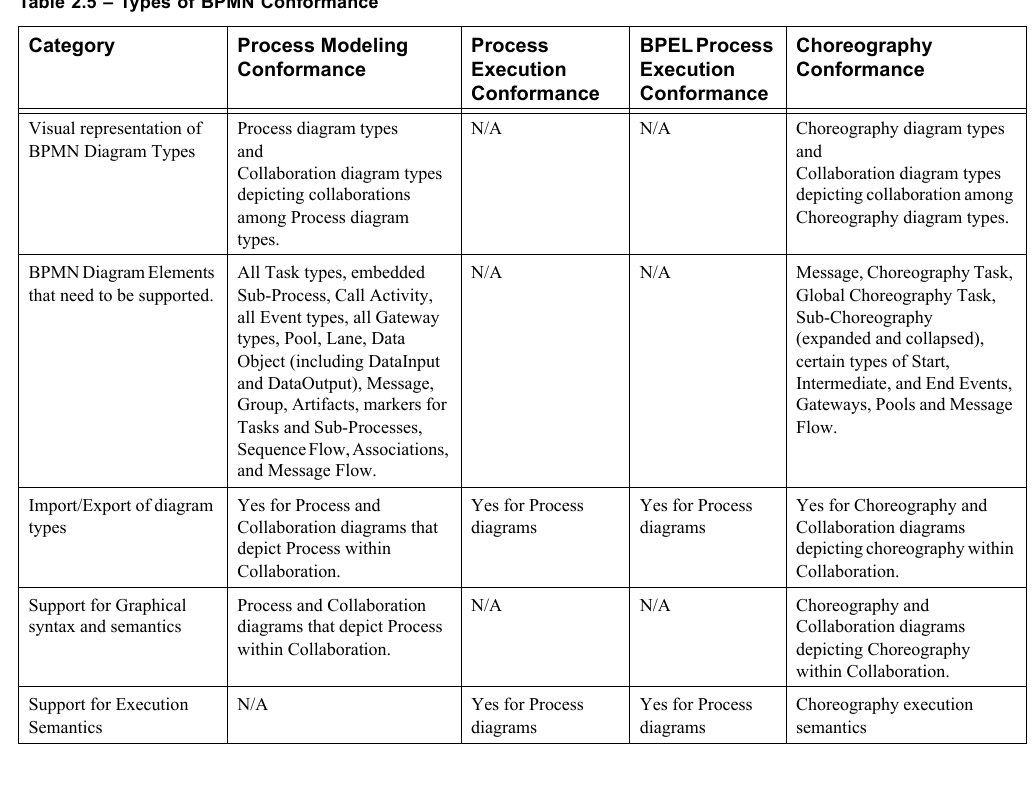
Table 2.5 summarizes the requirements for **BPMN** Conformance.
**Table 2.5 – Types of BPMN Conformance**